Neighborhood News: Wicker Park’s vibrant, artistic vibe
Located west of the Kennedy Expressway, east of Humboldt Park, and south of the Bloomingdale Trail, known for its nightlife and food scene, Wicker Park is a cultural center; its Historic District is on the National Register of Historic Places, and is designated as a Chicago Landmark District.
Wicker Park and nearby Bucktown are hives of activity that draw shoppers hunting for unique finds, foodies looking for the trendiest eats, and bar hoppers searching for that late-night buzz.
In the Beginning…
As Wikipedia sources tell it, in late 1868, the Chicago Board of Public Works announced the desire to build a park “lying west of Milwaukee avenue and south of North avenue. The grounds are of considerable capacity and are laid out in a tasteful and attractive manner as a park.”
Who was Charles Wicker?
Wicker Park was named in honor of Charles Gustavus Wicker (1820–1889), an early Chicago settler, alderman, state legislator, businessman, and real estate speculator who helped develop the surrounding neighborhood.
Wickerand his brother Joel purchased 80 acres of land along Milwaukee Avenue in 1870 and laid out a subdivision surrounding a four-acre park.
Growth
The Great Chicago Fire of 1871 spurred the first wave of development, as homeless Chicagoans looked to build new houses. Wicker Park was the abode of Chicago’s wealthy Germans and Scandinavians. The area provided an alternative to a population who had already been spurned by the Anglo- Protestant establishment residing on Chicago’s lakefront.
The fire also Influenced the architecture of Wicker Park, according to the Encyclopedia of Chicago. Having witnessed the vulnerability of wood construction, many Wicker Park residents built large mansions made almost entirely of brick and stone. By the 1890s the area was an architectural showplace, in a variety of styles, including Victorian Gothic and Italianate.
Many of these houses circled the four-acre park after which the community was named.
Not everyone who settled in Wicker Park, however, was wealthy and resided in a large house. By the late nineteenth century, Bell Avenue had become home to working-class African Americans and Eastern Europeans, especially Poles, who lived in small cottages dotting the street. Labor activists also resided in Wicker Park, including the martyrs of the Haymarket Affair.
With the end of the 19th century the area was subsumed into the surrounding. Polish Downtown, which gave the neighborhood its name, also became known as the “Polish Gold Coast”. The area around Division, Milwaukee, and Ashland was known as ‘Kostkaville,’ and the intersection retains the names “Polonia Triangle – Polish Triangle” today.
20th Century and Revitalization
Past the turn of the century, the provisional government of Poland met in Wicker Park during World War I.
Polish immigration into the area accelerated during and after World War II, when as many as 150,000 Poles are estimated to have arrived between 1939 and 1959 as Displaced Persons (DPs). They clustered in established ethnic enclaves like this one that offered shops, restaurants, and banks where people spoke their language. Division Street was referred to as ‘Polish Broadway.’
The novelist Nelson Algren’s literary output lionized the Division Street strip in books such as The Man with the Golden Arm and Never Come Morning, focusing on the stories of junkies, gamblers, hookers, and drunks in some areas of that neighborhood.
Today
As with many areas of Chicago, urban escape was the norm from the 50’s to the late 70’s. But then…efforts by community development groups like Northwest Community Organization (NCO) to stabilize the community through new affordable-housing construction in the 1980s coincided with the arrival of artists attracted by the neighborhood’s easy access to the Loop, cheap loft space in the abandoned factories, and distinctly urban feel.
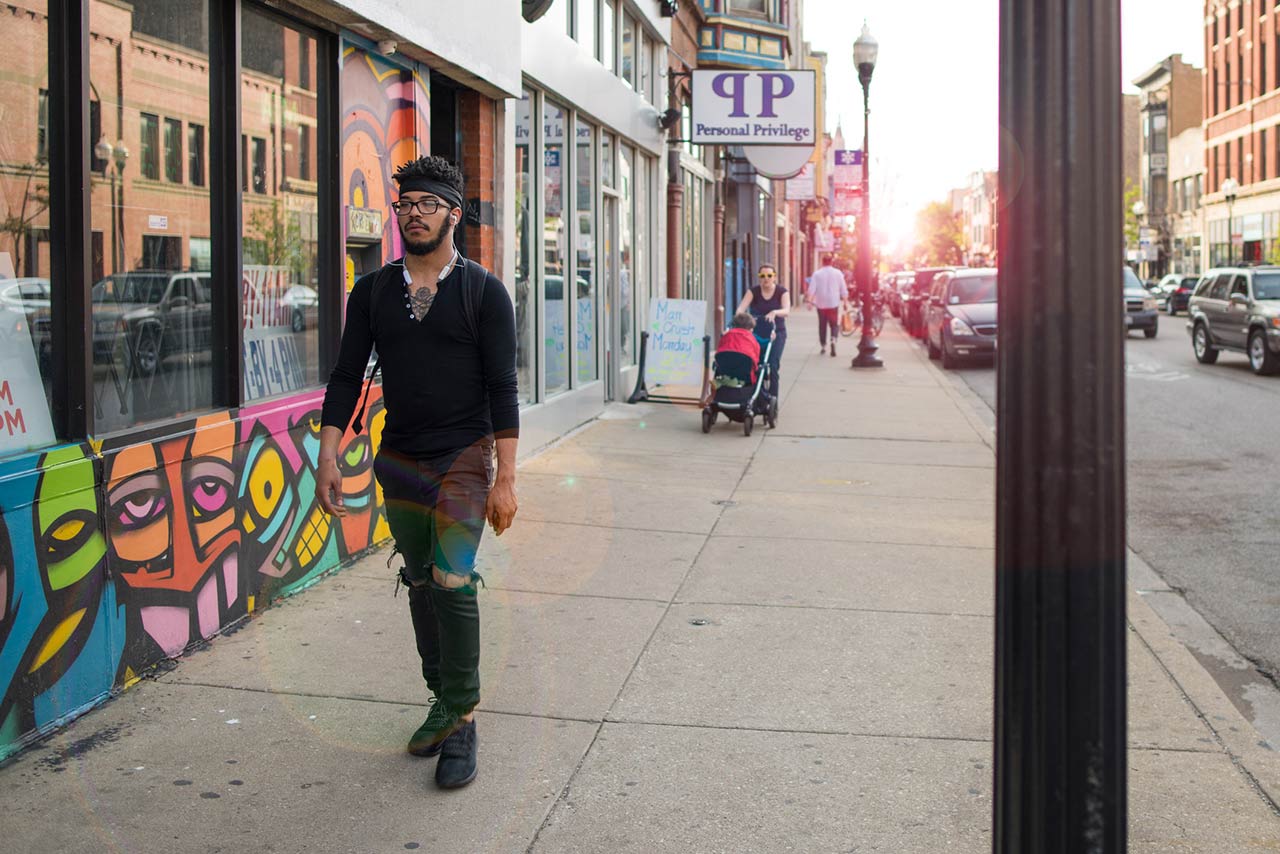
It was through this revitalization that Wicker Park became the artistic urban oasis it is today.
As Choose Chicago notes, the intersection of North, Damen, and Milwaukee Avenues (known as the Six Corners) is a great place to start.
If you’re looking for vintage clothing, dig through the racks at Vintage Underground, Kokorokoko, or Belmont Army.
Consider visiting the Flatiron Arts Building for a glimpse into the area’s artistic past, or catch a show at The Den Theatre. Don’t miss the Wicker Park Farmers Market for local produce and goods.
And for specifically enjoying these summer days, consider a stroll or leisurely bike ride along The 606 trail, (aka Bloomingdale Trail) where you can exploring the many parks, public artworks, murals, bars, and restaurants along the way.
Alison Moran-Powers and Dean’s Team Chicago