Neighborhood News: Near West Side’s historical Maxwell Street Market celebrates the birthplace of Maxwell Street Polish, Chicago blues, community
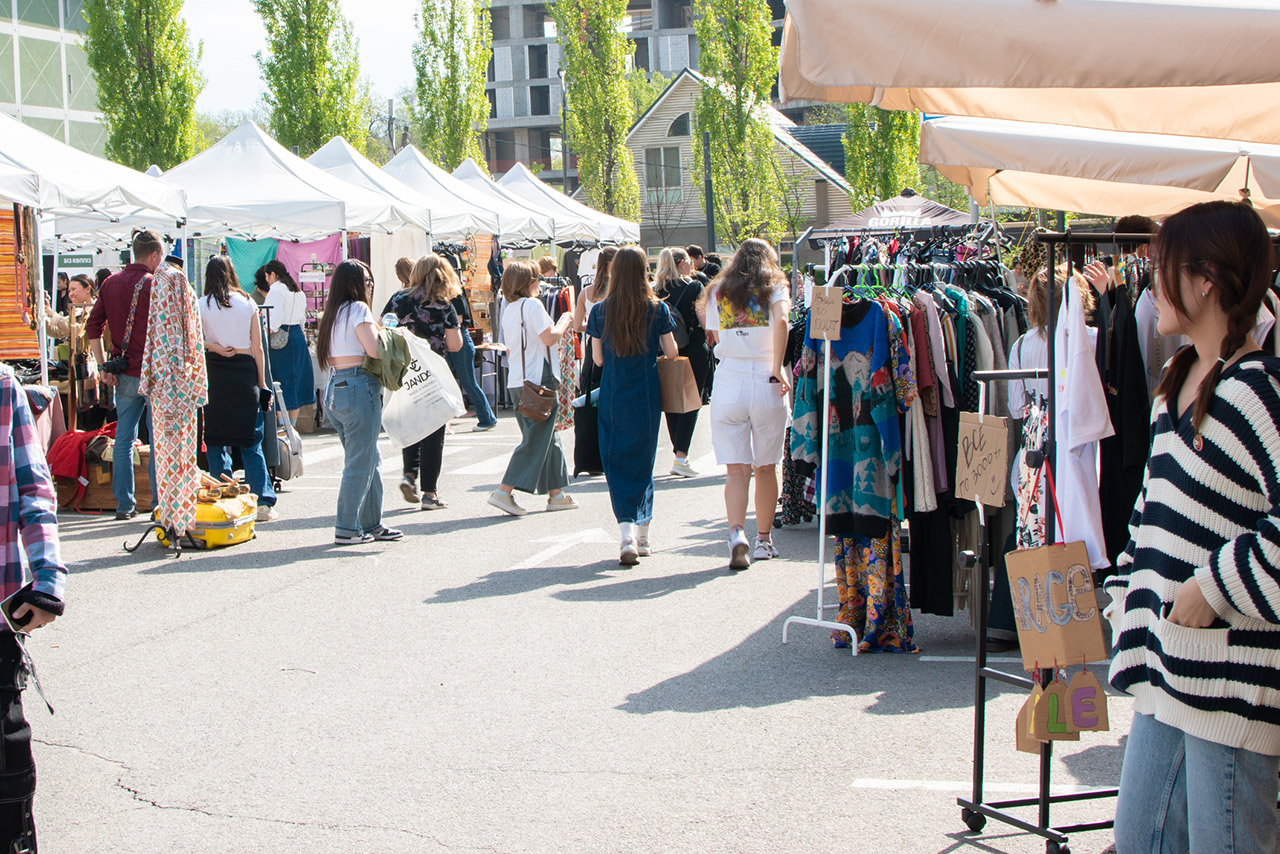
For more than 100 years, the Maxwell Street Market, between South Halsted Street and South Union Avenue, has featured an eclectic mix of arts, crafts, resale items, live music, and street food.
Located just south of the University of Illinois Chicago (UIC) campus, the area, as the City of Chicago’s website notes, is widely celebrated as the birthplace of Chicago blues and is famous for its open-air bazaar, eclectic food stands, and immigrant history.
With markets coming up on Sunday, July 19, Sunday, August 9, Sunday, September 13 and Sunday, October 4, from 10 am-3pm, there’s plenty of time to enjoy an eclectic mix of foods and finds—including handmade crafts, resale housewares, clothing, and much more.
And there’s interactive entertainment! On Sunday, July 19, from 11am- 3pm, SummerDance at Maxwell Street features dance lessons taught by professional instructors and music in the open air as part of Chicago SummerDance. At 11am, they’ll feature Salsa, followed by Cha-Cha. At 1pm, Teatro Tariakuri Dance and Theatre Performing Arts features the Cumbia, and at 1:30 pm, music for Salsa, Cha-cha, and Cumbia.
Throughout the market, live entertainment and programming from cultural partners are featured, as well as incorporating businesses and restaurants including several “Maxwell Street originals” like Express Grill, Hashbrowns, Jim’s Original Hot Dog, Lalo’s Mexican Restaurant and Bar Louie.
The ‘Ellis Island of the Midwest’
Originally, Maxwell Street was a wooden plank road that ran from the south branch of the Chicago River West to Blue Island Avenue. According to Choose Chicago, Maxwell Street first appeared on a Chicago map in 1847, named for Dr. Philip Maxwell, an Army surgeon who went on to become the State of Treasurer of Illinois.
The Original Maxwell Street Market was an impromptu market established in the late 19th century by newly arrived Jewish residents from Eastern Europe. On the Near West Side, according to Brittanica.com, Italian, Greek, and Jewish immigrants built communities and established businesses to cater to the local residents. Customers were able to haggle for goods in their own languages using Old World customs.
Maxwell Street Market was officially recognized by the City of Chicago in October 1912. As the website notes, before 1920 the Maxwell Street Market was believed to be the third-largest grossing retail district in Chicago. The market boasted a variety of vendors who sold everything from produce to appliances and animal feed, plus clothing and housewares.
As the Brittanica.com website notes, the streets were initially filled with Klezmer music, brought from Eastern Europe by Jewish immigrants. As the neighborhood changed, so did the music. When economic decline in the American South after World War I caused many Delta Blues and Jazz musicians – notably Louis Armstrong – to migrate north to Chicago, the first economically secure class willing to help them was the mostly Jewish merchants of the area around Maxwell Street, who by that time were able to rent or own store buildings.
In the 1930s and 1940s, Maxwell Street became known as a place where many black musicians, who migrated to Chicago from the segregated South, could be heard by the greatest number of people. The musicians quickly realized that they needed amplifiers or electrical instruments in order to be heard over the barking vendors and noisy crowds. The resulting amplified and distinct Chicago blues sound was made famous by practitioners such as Muddy Waters, Junior Wells, and Bo Diddley—the latter of whom played on Maxwell Street with his band, the Hipsters.
One of the early food vendors at the market included Jim’s Original, which started serving hot dogs in 1939 and created the now-iconic Maxwell Street Polish sausage sandwich—a grilled Polish sausage with grilled sweet onions and smear of mustard—in 1943. Other immigrant groups, such as Mexican immigrants who began arriving in the mid-1910s, further diversified the sights, smells, and sounds of the market.
By the 1950’s and 60’s, with Chicago retailers expanding to the suburbs and Chicago residents fleeing to the suburbs, as well as expansions of the University of Illinois at Chicago and Dan Ryan Expressway, Maxwell Street Market fell by the wayside and into disrepair.
That said, Maxwell Street was featured in the 1980 film The Blues Brothers, portrayed as a thriving African-American community, with John Lee Hooker playing his song “Boom Boom.”
In 1994, the Maxwell Street Market was moved by the City of Chicago to accommodate expansion of the University of Illinois at Chicago. It was relocated a few blocks east to Canal Street and renamed the New Maxwell Street Market. It was moved again to Des Plaines Avenue in September 2008, and finally experienced a renaissance in 2024 with a return to its original spot.
Today, Maxwell Street Market is easily available by public transportation. Take the CTA Blue Line to the Halsted Street station, or the #8 Halsted Street bus and the #12 Roosevelt Street bus. For more information click here.
Alison Moran-Powers and Dean’s Team Chicago